Signs Your Pool Lights Need Repair
Pool lighting problems range from burned-out bulbs to active electrical faults. Some are simple. Others are genuine safety concerns. All of them require a licensed technician to evaluate correctly.
- Lights flickering or dimming during operation without a clear cause
- Lights that fail to turn on even after resetting the circuit breaker
- Visible water inside the light fixture or lens — indicating a failed seal
- Cracked, discolored, or corroded light housing
- Circuit breaker tripping repeatedly when pool lights are switched on
- Humming or buzzing sound coming from the fixture during operation
- Noticeably yellowed or cloudy lenses reducing light output
Pool Lighting Problems We Diagnose and Fix
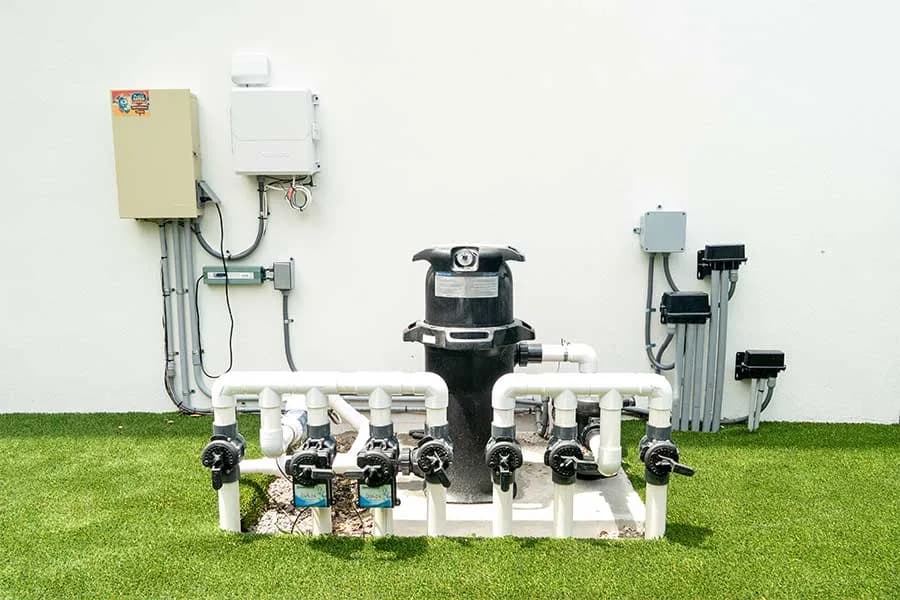
Pool lighting problems fall into three categories: fixture failures, wiring and conduit issues, and GFCI or transformer faults. Getting the category right before starting a repair is what separates a lasting fix from one that sends you back to the same problem.
Fixture failures include burned-out bulbs, cracked or failed lenses, degraded gaskets and O-rings that allow water infiltration, and corrosion at the socket or internal connections. These are the most straightforward repairs when the conduit and wiring behind the fixture are intact.
Wiring and conduit problems are more involved. Pool light conduit runs from the fixture niche through the pool shell to the junction box. When conduit shifts, cracks, or fills with water, moisture reaches the wiring — and if the wiring has been compromised, a full rethread or wire replacement is necessary. We hold the electrical license to handle this work correctly.
GFCI and transformer faults are the third category. A pool light circuit that trips the GFCI repeatedly is showing a ground fault that needs to be diagnosed and corrected at the source, not just reset. We identify where the fault originates and repair it there.
Replacement & LED Upgrades
Knowing when to replace rather than repair saves money and avoids repeated service calls on a fixture that is past its useful life. Replacement is the right call when:
- Fixture housing is cracked or has allowed water infiltration that damaged internal components
- Corrosion inside the niche is too severe for a new seal to hold
- Compatible replacement parts are no longer available for the fixture
- Upgrading to LED and the existing housing is not compatible with a direct conversion kit
LED pool lights are the most common upgrade choice. They use up to 80 percent less electricity than incandescent fixtures, typically provide 15,000 to 30,000 hours of operation, and are available in single-color white or full-spectrum color-changing configurations that connect to pool automation controllers or smartphone apps. Most LED retrofit kits fit standard niche sizes, making the swap straightforward when conduit and wiring are in acceptable condition.
For replacements and new installations we handle the complete scope: removing the old fixture, preparing the niche, installing the new light with correct gaskets and sealants, making all electrical connections under our own license, and testing the completed installation through a full operating cycle. We make the repair-vs.-replacement call based on the fixture's actual condition and a clear cost comparison — you get an honest recommendation before any work begins.
How Our Pool Light Repair Process Works
Every pool light call starts with a full safety inspection of the circuit: fixture, niche, conduit, wiring, transformer, and GFCI protection. We do not skip upstream components when the visible problem appears to be at the fixture — that is how misdiagnoses happen.
Once the inspection is complete, we give you a clear explanation of the fault and a quoted price before any repair work begins. Repairs are completed to code, tested under operating conditions, and backed by our warranty.
Frequently Asked Questions
Is a failed pool light dangerous?
A simple burned-out bulb is not an immediate safety risk. However, a fixture tripping breakers, showing water inside the lens, or producing unusual behavior indicates an electrical fault. The pool should not be used until a licensed electrician has inspected and cleared the circuit.
Do you have to drain the pool to repair a light?
Many pool light repairs can be completed without draining the pool. Fixtures are typically mounted in a niche that can be pulled to the deck for servicing. Whether draining is required depends on the specific repair, which we advise on after the inspection.
Why does my pool light keep tripping the GFCI?
Repeated GFCI trips indicate a ground fault in the circuit. Common causes include water infiltration into the fixture, degraded wiring inside the conduit, or a faulty transformer. This fault must be diagnosed and repaired at the source.
Is your pricing upfront?
Yes. We provide upfront pricing on every pool light repair before work begins.
Do you handle all types of pool light repairs?
Yes. We handle bulb replacements, full fixture replacements, gasket and O-ring replacements, and complete lighting circuit repairs. If an LED upgrade makes sense at the time of repair, we present that option with a clear cost comparison.