
Signs Your Pool Is Leaking
Every Florida pool loses some water to evaporation — roughly a quarter inch a day in summer heat. A leak loses more, and it usually announces itself in ways homeowners write off as normal. If any of these sound familiar, it's time to test.
- Water level dropping faster than evaporation — more than about a quarter inch per day
- The bucket test shows it: a bucket of pool water on the step loses less water than the pool itself
- Chemical use creeping up — constantly re-dosing because fresh fill water dilutes the balance
- Soggy or unusually green spots in the yard around the pool or along plumbing runs
- Pump losing prime or sucking air — often a suction-side plumbing leak
- Cracks, gaps, or persistent damp areas around the pool deck or equipment pad
How We Find the Leak
Guessing is expensive. Digging up a deck to "look for the leak" is how pool owners end up paying for repairs they didn't need. We isolate the leak first, then quote the repair — using the method the symptoms call for.
- Pressure testing — each plumbing line is isolated and pressurized to confirm whether it holds. A line that loses pressure is a line that leaks, and we can narrow down where.
- Dye testing — with the water still, dye is released near suspect points: fittings, skimmer throats, returns, cracks, and the light niche. Dye pulled into a void marks the leak visually.
- Electronic listening — acoustic equipment picks up the sound of water escaping underground plumbing, letting us pinpoint a break under the deck or yard without exploratory digging.
What We Repair
Detection and repair under one roof means no second contractor, no re-diagnosis, and no gap between finding the problem and fixing it.
- Underground and above-ground plumbing line repairs — suction and return side
- Fitting and seal replacement at skimmers, returns, and equipment pad connections
- Light-niche leak repairs — a common and commonly misdiagnosed leak point
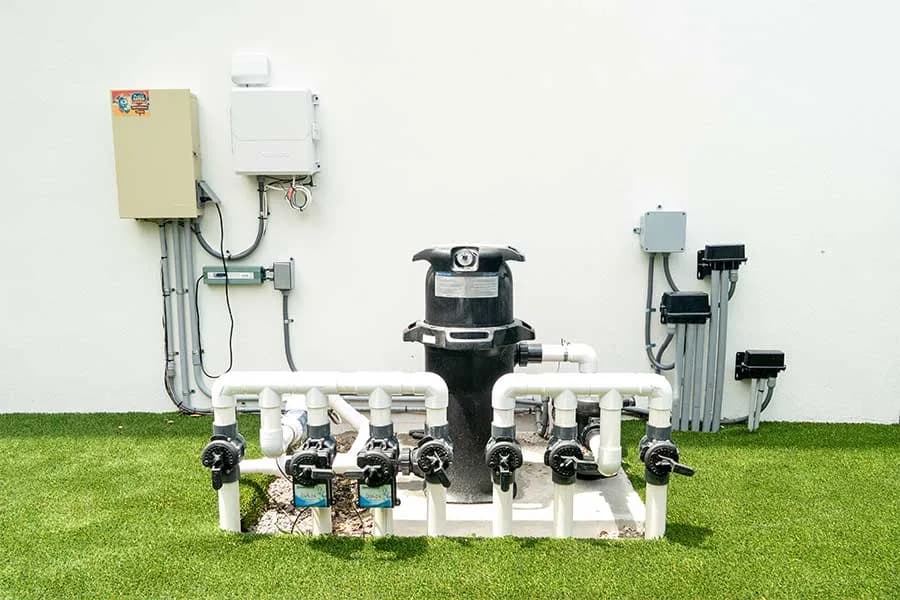
- Equipment pad leaks at pumps, filters, valves, and unions
Light niches deserve a special note: the niche is both a plumbing penetration and an electrical fixture, which makes it an electrical-adjacent repair most pool companies have to sub out. We hold both the pool and electrical contractor licenses, so the same team can open, repair, and rewire a leaking light niche safely — one visit, one company responsible. See our pool light repair service for the full lighting side.
What Happens After Detection
You never get a shrug and an invoice. Every leak detection ends with written findings — where the leak is, how we confirmed it, and what it will take to fix — plus an upfront repair quote before any repair work begins. If you approve, we schedule the repair; if you want to think it over, you keep the findings either way.
Frequently Asked Questions
How do I know if my pool is leaking or just evaporating?
Run the bucket test. Fill a bucket with pool water, place it on a pool step, mark the water level inside and outside the bucket, and check after 24 hours with the pump off. Evaporation affects both equally — if the pool level dropped noticeably more than the bucket, you have a leak.
How do you find a pool leak without digging?
We isolate it first: pressure testing confirms which plumbing line is losing water, dye testing pinpoints leaks at fittings, cracks, and the light niche, and electronic listening equipment locates underground breaks acoustically. Digging only happens once we know where the leak is.
Can a pool light really be the source of a leak?
Yes — the light niche is one of the most common leak points, because it penetrates the pool wall and carries conduit. It is also an electrical fixture, so repairing it properly requires electrical credentials. We handle light-niche leaks under both our pool and electrical contractor licenses.
What do I get after the leak detection?
Written findings — where the leak is and how we confirmed it — plus an upfront quote for the repair. Nothing is repaired without your approval, and you keep the findings either way.
Do you repair the leak too, or just find it?
Both. We repair plumbing lines, fittings and seals, light-niche leaks, and equipment pad leaks — same team, no second contractor.